

Introducing Estimate: accurate delivery dates that convert shoppers and cut costs

.png)
Estimate is a machine learning-powered API that returns estimated delivery dates with ≥90% accuracy. It gives businesses a reliable date to show at checkout, trained on real delivery outcomes from millions of shipments, not carrier-stated transit times. One API call returns a date your shoppers can trust, along with the cheapest way to keep it.
Why delivery uncertainty is costing you more than you think
Delivery uncertainty costs you twice: the sales you don't win, and the shipping you overpay for.
The problem is that most delivery date tools rely on carrier-stated transit times, which are the carrier's published best-case scenario. Those estimates don't account for the things that actually affect delivery, including weather events, hub congestion, seasonal surges, and carrier performance that varies by route, day of week, and time of year. The result is a date you can't stand behind, so most businesses don't show one at all.
How Estimate works
Step 1: Send the details
.png)
Your engineering team makes a single API call with origin ZIP, destination ZIP, and package dimensions. Set a maximum acceptable delivery date, and Estimate will filter out anything that can't meet it.
Step 2: Run the prediction
.png)
Our machine learning model returns an estimated delivery date at the confidence level you set. The model accounts for seasonal carrier performance, U.S. holidays, and route-level variance. For routes with limited shipping history, it automatically falls back through a hierarchy of backup models and tells you which source was used in the response.
Step 3: Show it where it matters
.png)
Display the date to shoppers as a single date ("Arrives Nov 22") or a date range ("Arrives Nov 21–23") on product pages, at checkout, or both. Or use the estimate to inform carrier selection, finding the cheapest option that meets your delivery promise before you buy the label.
How to use Estimate across your business
Win shoppers before they hesitate
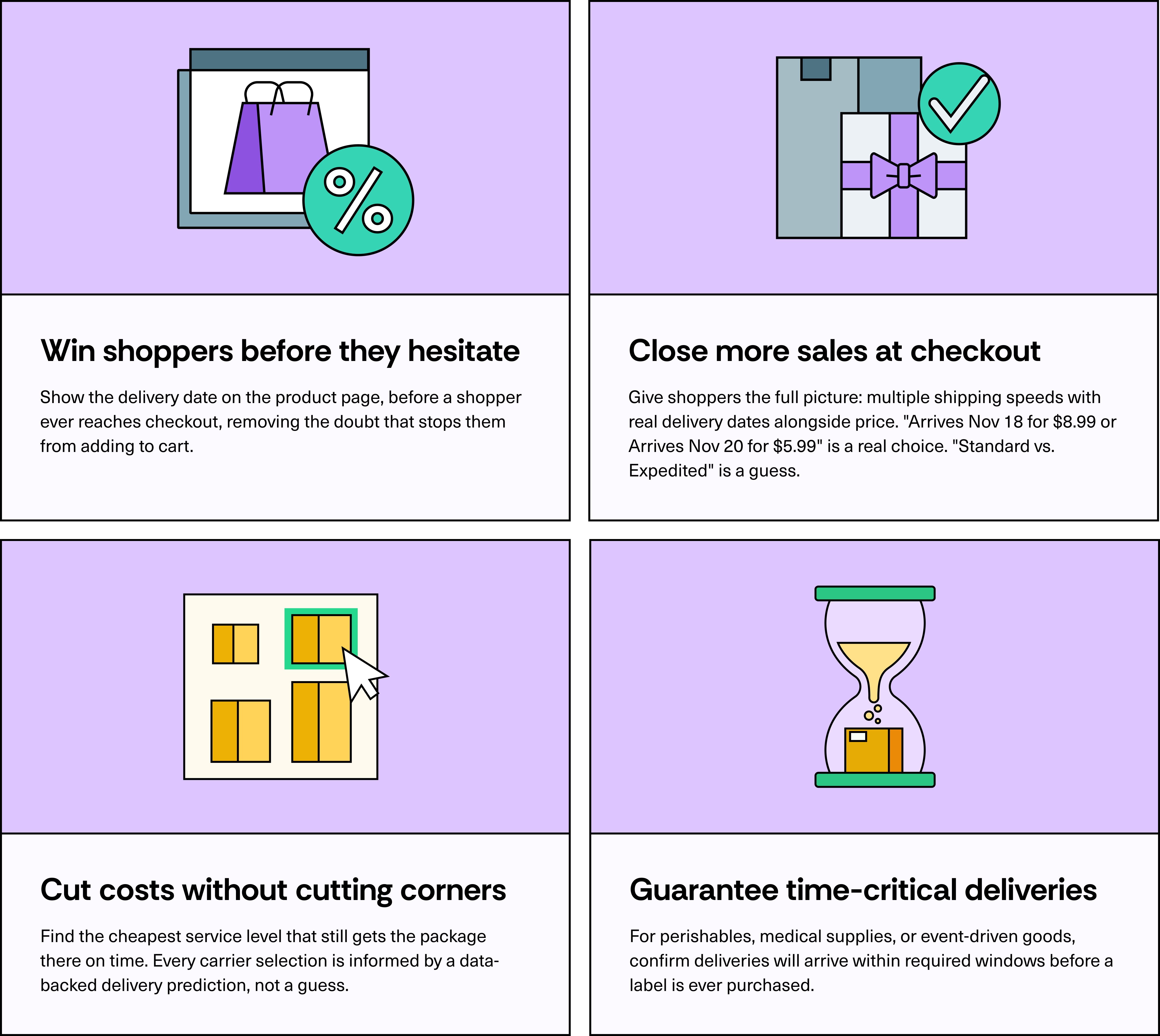
The product page is where doubt lives. A shopper sees something they want but without knowing when it will arrive, they hesitate, and hesitation is where you lose the add-to-cart.
Estimate lets you surface a real delivery date at the product page level, before a shopper ever reaches checkout. The result is a date they can plan around: "Arrives November 22" instead of "ships in 3–5 business days."
Convert more sales at checkout
Checkout is where delivery uncertainty does the most damage. When shoppers see vague ranges or no date at all, they're being asked to make a buying decision with incomplete information. Many don't.
Estimate makes the choice concrete. "Arrives Nov 22 for $8.99" or "Arrives Nov 24 for free" gives shoppers everything they need to decide. Standard vs. Expedited leaves them guessing.
Cut shipping costs without cutting corners
Most businesses pick carriers out of habit or rule-of-thumb, and overpay as a result.
What we found in July 2026: Cheaper usually doesn't mean slower
Across Shippo's platform, 85% of merchants shipping 100+ labels a month had at least one order that could have cost less to ship and arrived just as soon — or sooner. When a cheaper option existed, it was 22% cheaper on average, or $5.26 less per label. And here's the part that surprised us: in 44% of those cases, the cheaper option was scheduled to arrive sooner than what the merchant actually bought.
That changes what kind of problem this is. If picking the wrong rate only ever cost you money, a spreadsheet and a rule of thumb would mostly handle it. But when the cheaper option is also the faster one nearly half the time, there's no rule of thumb to apply. The answer depends on the carrier, the lane, the service level, and the week. It's a prediction problem.
That's the case for putting a model on it. Estimate checks every carrier and service level against the date you need to hit, then keeps only the options that qualify, so the cheapest one that still makes your promise is the one you see.
Protect time-critical deliveries
For some shipments, the delivery date is not a nice-to-have. Cold-chain pharmaceuticals need to arrive before temperature tolerance is exceeded. Event-driven goods need to arrive before the event. And perishables have a hard deadline.
Set the confidence level to High and pass a maximum acceptable delivery date. Estimate filters out every carrier and service level that can't meet the window. You only see options you can stand behind, and you know before buying the label, not after.
What makes Estimate different
Built on one of the largest shipping datasets in ecommerce
Carrier-stated transit times are optimistic by design. They reflect ideal conditions, not the real-world variability that determines whether your package actually arrives when expected.
Estimate is trained on actual delivery outcomes across millions of shipments, including real performance by route, day of week, seasonal pattern, and carrier network. The model accounts for things carriers don't publish: hub congestion, weather impact history, and holiday handling variation by service level.
Accurate enough to actually show
Basic EDD tools are built on transit time tables with a confidence interval wide enough to be useless in a checkout UI. Estimate targets ≥90% accuracy, meaning the package arrives before or on the promised date for 9 out of 10 shipments. That's a number you can put in front of shoppers.
And it comes from a track record. 93% of businesses using Estimate say it helps them choose the best service level. 81% feel more confident about when their shipments will arrive.
Live in a sprint, not six months
Enterprise EDD platforms require lengthy implementation timelines and custom contracts. Estimate is a single endpoint with SDK support in Python, Ruby, JavaScript/Node.js, and PHP. Your team can go from zero to live in a single sprint. Use the interactive API explorer in our docs to try requests before writing a single line of integration code.
Start adding delivery dates that convert shoppers and cut costs
Estimate is $0.03 per call, with no monthly minimums.
Contact an expert or explore the API docs to see how the integration works.
Looking for a multi-carrier shipping platform?
With Shippo, shipping is as easy as it should be.
- Pre-built integrations into shopping carts like Magento, Shopify, Amazon, eBay, and others.
- Support for dozens of carriers including USPS, FedEx, UPS, and DHL.
- Speed through your shipping with automations, bulk label purchase, and more.
- Shipping Insurance: Insure your packages at an affordable cost.
- Shipping API for building your own shipping solution.
Stay in touch with the latest insights
Be the first to get the latest product releases, expert tips, and industry news to help you save time and money on shipping.
Loading...
Thanks for your submission!



.png)


