How USPS prepaid return labels work (and how to send one)

A USPS prepaid return label is postage you buy in advance and send to your customer so they can ship an item back at your cost. Buy it as a scan-based return label and USPS bills you only when the customer actually ships the package. Unused labels cost nothing, and USPS return labels stay valid for 365 days.
This guide covers what a prepaid return label costs, the three USPS return services you can choose from, how to get the label into your customer's hands (including as a QR code), and how long it stays valid.
In this article
- What is a USPS prepaid return label?
- What does a USPS prepaid return label cost?
- How do you send a USPS prepaid return label?
- Can you send a return label as a QR code?
- How long is a USPS return label valid?
- Is offering prepaid returns worth it?
- FAQ: USPS prepaid return labels
What is a USPS prepaid return label?
A prepaid return label is a shipping label the seller pays for, addressed from the customer back to the seller. It carries the same elements as any USPS label: both addresses, proof of paid postage, and a barcode USPS scans along the route. The difference is who pays and which direction the package travels.
"Prepaid" describes who owes the postage, not when the money moves. On a scan-based return label the seller is billed at the first USPS scan, so a label that never gets used never generates a charge.
The customer's side is simpler than most people expect: they attach the label and hand over the package, with no postage to buy, no form to fill in and no counter visit.
On the receiving end? Print the label, tape it over any old label so only one barcode is visible, and hand the package to a mail carrier or drop it at a USPS location. Keep the tracking number until your refund lands.
A collection box works too, provided the package fits. The familiar 10 oz limit on collection boxes applies to mail bearing postage stamps, and a printed prepaid label is not a stamp.
What does a USPS prepaid return label cost?
Nothing until it is used. Every USPS return service is scan-based, so you pay per label scanned rather than per label created. That is what makes it practical to put a return label in every outgoing box.
When one does get used, a cross-country return runs about this much:
| Package weight | USPS Ground Advantage | USPS Priority Mail |
|---|---|---|
| 1 lb | $10.01 (5 days) | $11.41 (3 days) |
| 3 lb | $10.05 (5 days) | $14.51 (3 days) |
| 5 lb | $10.43 (5 days) | $14.51 (3 days) |
Shippo commercial rates pulled Aug. 27, 2026, for a 10 x 8 x 4 in package going from ZIP 10001 (New York, NY) to ZIP 94103 (San Francisco, CA). Your rate will vary by origin, destination, weight, and dimensions.
Ground Advantage barely moves across those weights: 42 cents between 1 lb and 5 lb, against $3.10 for Priority Mail over the same range. That matters for returns: since the customer decides what goes back in the box, you are pricing a package you have not seen, and a flat curve protects you there.
All three USPS return services are scan-based, with no minimum volume:
| USPS return service | Typical delivery | Max weight | Insurance included |
|---|---|---|---|
| USPS Ground Advantage Return | 2 to 5 days | 70 lbs | $100 |
| Priority Mail Return | 2 to 3 days | 70 lbs | $100 |
| Priority Mail Express Return | 1 to 3 days | 70 lbs | $100 |
Service details and the scan-based payment terms come from USPS's return services page. Each carries $100 of USPS coverage that can be raised to $5,000. Ground Advantage is often the default, since a return rarely needs to move faster than the outbound shipment did. See our guide to USPS Ground Advantage for the full service.
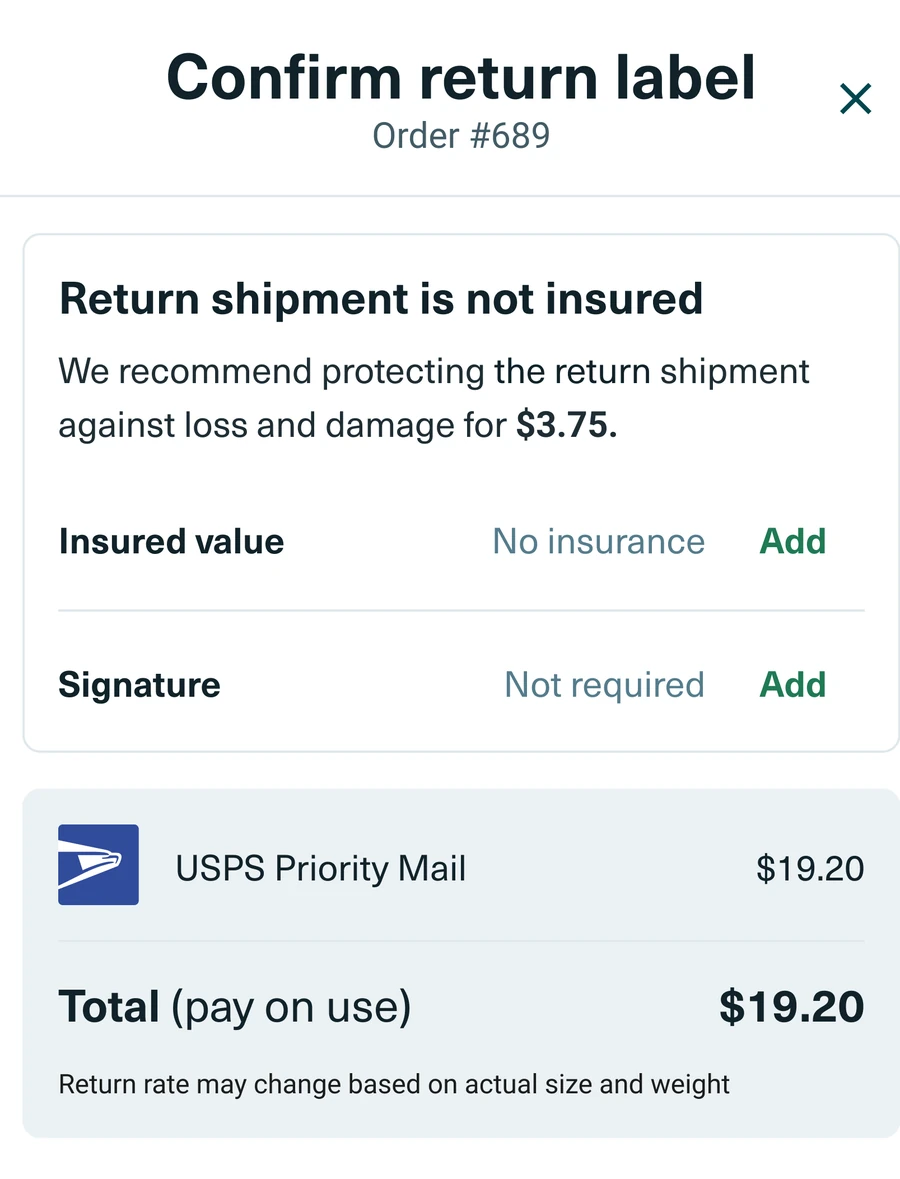
That panel above will look like it contradicts the $100. It marks the return shipment "not insured" and offers to add protection against loss and damage for a fee. Both are true at once: the $100 is USPS carrier liability built into the service, and the panel is selling optional coverage layered on top of it. Above $100 the add-on is worth considering, though the decision is not automatic: weigh the cost of coverage against the loss you are comfortable absorbing and how often returns actually go missing. Our take on whether shipping insurance pays for itself covers the arithmetic.
A return label created alongside an outbound shipment inherits the outbound package details, so a five-item order quotes the five-item rate even if the customer only sends two items back. Shippo flags this in the purchase panel: the rate may change based on the package's actual size and weight once USPS handles it. Treat the quoted figure as an estimate rather than the final charge. Where returns are usually partial, create the return label on its own once the customer tells you what they are sending back, and enter the real weight then.
How do you send a USPS prepaid return label?
Three delivery methods cover almost every case: put a printed label in the outbound box, email a PDF when the customer asks for one, or send a QR code the customer redeems at a Post Office. Which one fits depends on your return rate and how much you want the customer to have to do.
The rest of this section is the Shippo version of those three, built on scan-based return labels. On another platform the three shapes still apply; only the clicks differ.
Settle one thing before you pick a route: which carrier the return travels on. A return label created inside the outbound purchase flow inherits that shipment's carrier and service level. One created later does not, which makes the later route the one to pick if you want returns moving on a cheaper ground service than the outbound shipment used. All three routes are domestic only, because an international shipment needs customs documentation a return label cannot carry. Shippo's return label guide covers each one step by step.
Create the return label with the outbound label
From the Orders page, select the order, open Options in the sidebar, then select Create a Return Label and continue through your normal label purchase. Shippo swaps the sender and recipient addresses and reuses the outbound package details, carrier, and service level. Clicking Download Label afterwards gives you both labels in one file, which is what makes the label-in-the-box method practical at volume. Best for categories where returns are common enough that the label pays for itself in support tickets avoided.
Create a standalone return label later
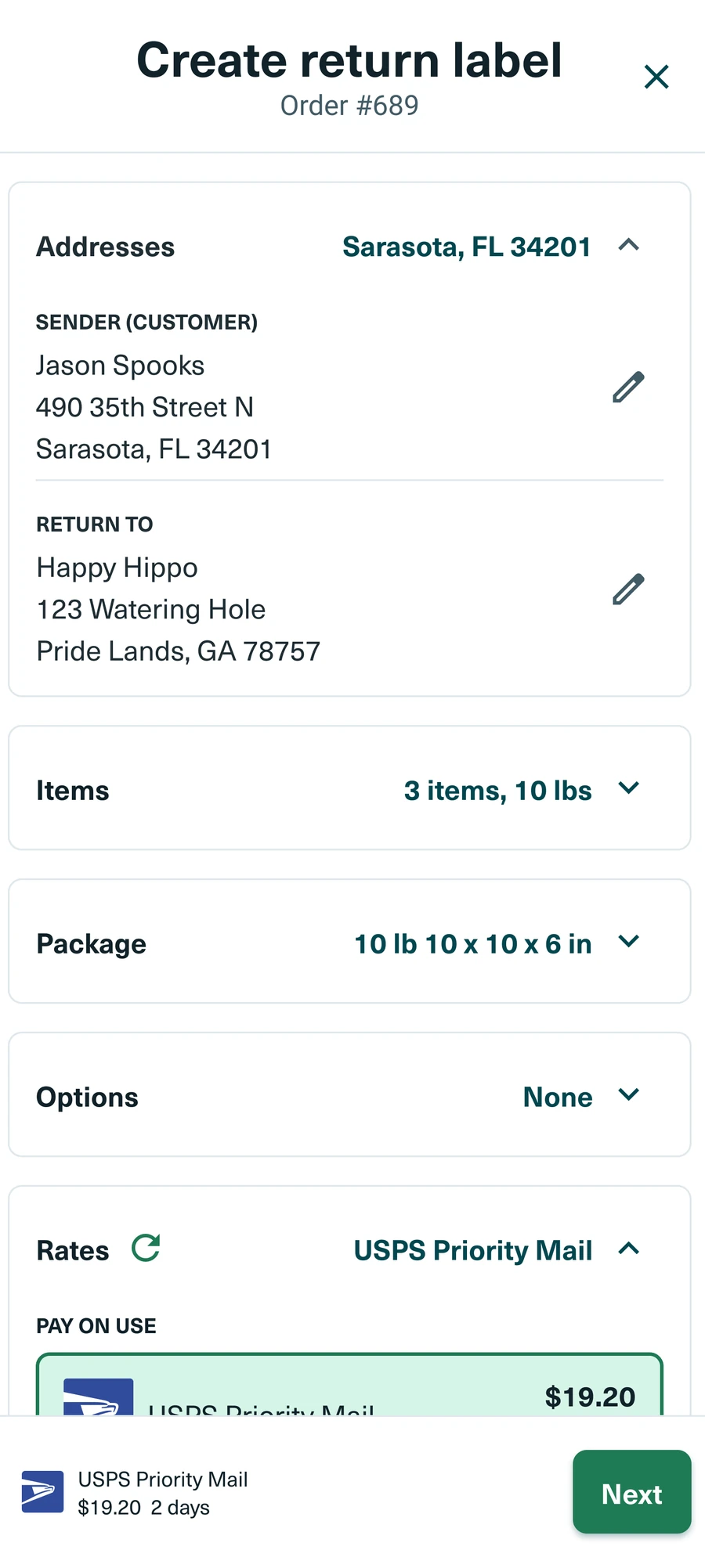
Open the drop-down on the shipment from the Shipments or Orders page, select Create Return Label, enter the package dimensions and weight, click Next, then Create return label and download it to email to the customer. This route gives you more control than the first one: you can change the weight and dimensions, add signature confirmation, and pick a different carrier and service level than the outbound shipment used. Use it when returns are partial or infrequent. Purchased return labels appear on the Shipments page tagged Return.
Auto-create a return label for every order
Go to Settings > Labels & packing slips, scroll to Return Label Options, check Auto-create return labels for outbound shipments, and save. Every outbound label bought after that generates a matching pay-on-use return label. Worth turning on once your return rate is predictable enough that the outbound weight is a fair proxy for the return weight.
Can you send a return label as a QR code?
Yes, and it solves the customer who has no printer. USPS Label Broker holds the label on the USPS side and gives the customer a code to redeem in person. They show it to a retail associate at the counter or scan it at a self-service kiosk, and USPS prints the label and hands it over. The package has to be sealed and ready to ship before they go, because nothing gets repacked at the counter.
Shippo generates these through the API for USPS, Royal Mail and Evri: set qr_code_requested to true in the shipment's extra parameters and the completed transaction returns a qr_code_url you can email to the customer. Shippo's QR code documentation has the full flow. Because this is an API capability rather than a web app one, labels bought in the Shippo app carry no QR option today.
Without API access the better fix is to stop the problem arising. Include the return label in the outbound box, using the auto-create setting above, and printing never becomes the customer's problem in the first place. It costs nothing extra, since an unused scan-based label is never billed.
How long is a USPS return label valid?
The window is 365 days from the date the label is created. Miss it and you generate a fresh one at no cost, since an unscanned scan-based label was never billed in the first place. Validity differs sharply by carrier, which matters if you offer returns across more than one:
| Carrier | Return label valid for |
|---|---|
| USPS | 365 days |
| UPS | 100 days |
| FedEx | 2 years |
Those windows apply to return labels created in Shippo and come from Shippo's returns documentation. UPS is the outlier. At 100 days it is roughly a quarter of the USPS window, short enough that a holiday purchase returned in spring can fall outside it. Carriers sometimes still accept an expired label, but the shipment can be flagged, returned, or destroyed with no refund available. For the full picture on expiration and what happens to a label past its date, see how USPS return label expiration works.
Is offering prepaid returns worth it?
The economics changed once scan-based pricing removed the upfront cost. Before that, a label in every box meant paying for returns that never happened.
Demand for easy returns keeps climbing. NRF and Happy Returns found that 82% of consumers treat free returns as a major consideration when buying, up from 76% a year earlier, and that 19.3% of online sales were returned in 2025. Their figures come from a summer 2025 survey of 2,006 consumers who had returned at least one online purchase in the previous 12 months.
For most sellers the answer is yes, on the economics rather than the customer-experience argument: a label you are not billed for until it is scanned costs nothing to offer. Returns also travel on your account at your rates instead of what a customer would pay at a retail counter.
That leaves one decision. Absorb the postage where margins allow and the item is worth having back; deduct it from the refund on low-margin or high-return categories where free returns invite bracketing. If you are still choosing a carrier for the outbound leg, our USPS vs. UPS vs. FedEx rate comparison covers that side.
FAQ: USPS prepaid return labels
Can I add postage to a prepaid label if the package is heavier than expected?
No. Pricing is locked to the weight and dimensions entered at purchase, and there is no way to top it up afterwards. If the package runs heavier or larger, USPS Automated Package Verification catches it during processing and bills the difference back through the platform that sold the label. You have 60 days from the notification to dispute an adjustment. Void the original and issue a correctly weighted label instead.
What happens if the customer never ships the return?
Nothing is charged. A scan-based label bills at first scan, so an unused label generates no cost and needs no cancellation. It simply lapses at the end of its validity window.
Can I send a prepaid label to someone who is not returning a purchase?
Yes. Nothing about the label requires an original sale. The same mechanism covers warranty repairs, trade-ins, borrowed equipment, or sending postage to a family member. Buy the label with their address as the sender and yours as the recipient.
How can I tell whether a label I was sent is prepaid?
Look for the postage indicia in the top-right corner, the block of small print where a stamp would sit. A prepaid label shows the service name and a paid-postage marking there. A label reading "postage due" or carrying no indicia at all has not been paid for, and the Post Office will ask you to cover it at drop-off.
Can I create an international return label?
Not through Shippo. Return labels are domestic only, because an international shipment needs customs forms that a return label does not include. Cross-border returns have to be arranged as a new international shipment with its own documentation.
Looking for a multi-carrier shipping platform?
With Shippo, shipping is as easy as it should be.
- Pre-built integrations into shopping carts like Magento, Shopify, Amazon, eBay, and others.
- Support for dozens of carriers including USPS, FedEx, UPS, and DHL.
- Speed through your shipping with automations, bulk label purchase, and more.
- Shipping Insurance: Insure your packages at an affordable cost.
- Shipping API for building your own shipping solution.
Stay in touch with the latest insights
Be the first to get the latest product releases, expert tips, and industry news to help you save time and money on shipping.
Loading...
Thanks for your submission!